Blog / AI & Data Governance in Africa
Africa’s AI Talent Pipeline: Governance Strategies to Retain Innovators and Combat Brain Drain
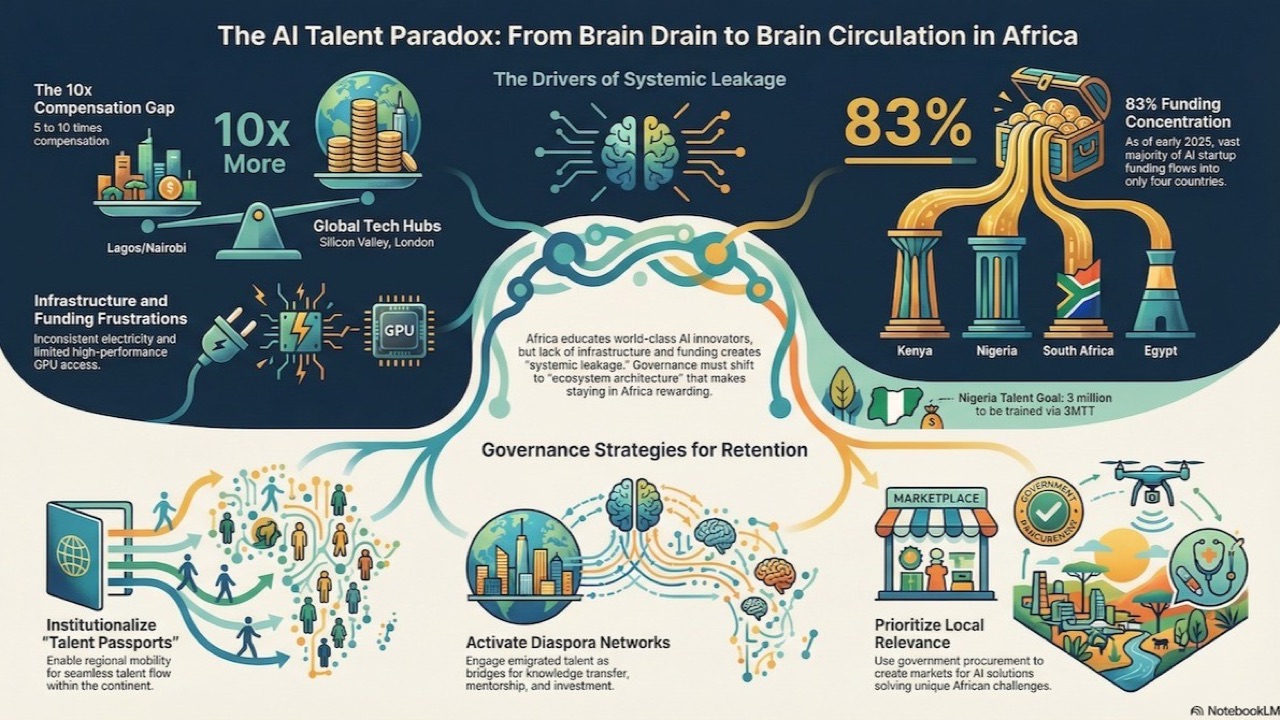
Africa’s AI narrative is often split into two competing storylines. The first is one of brilliant, against-all-odds success: the self-taught coder in Lagos building computer vision models from YouTube tutorials; the PhD graduate from Accra leading a research team at a global tech giant; the Nairobi-based startup securing Silicon Valley funding. We celebrate these individuals, and rightly so.
The second storyline is one of systemic leakage. It is the quiet departure of that same coder for a Berlin research lab, the graduate accepting a permanent position in Toronto, the startup relocating its headquarters to San Francisco after its first major funding round. Yet too often, African genius is ultimately platformed abroad, for foreign priorities, and within foreign innovation ecosystems.
This is the central paradox of Africa’s AI moment: we are educating and inspiring a generation of world-class talent, only to see them become the architects of value elsewhere. Brain drain is not a new phenomenon, but in the context of artificial intelligence, a field where competitive advantage is built on concentrated high-end human capital, it takes on an existential dimension. Losing our top AI innovators is not just losing people; it is forfeiting our sovereign capacity to build, govern, and benefit from the defining technology of our age.
State of AI Talent in Africa
Africa’s tech ecosystem hosts vibrant hubs in Lagos, Nairobi, Cape Town, Cairo, and Accra. It produces thousands of STEM graduates annually and has seen exponential growth in AI-related education programs. Universities and research institutions across South Africa, Ghana, Kenya, and Nigeria, and initiatives like Data Science Africa and Deep Learning Indaba are cultivating world-class talent. Young Africans are winning international AI competitions, publishing in top-tier journals, and founding innovative startups that apply AI to solving Africa's unique challenges, from agricultural optimization to healthcare diagnostics.
Yet this talent increasingly flows outward. African AI professionals migrate to North America, Europe, and parts of Asia, attracted by higher salaries, stronger research infrastructure, and more mature innovation ecosystems. The loss extends beyond individual careers; it represents a steady erosion of human capital that Africa has invested in educating, precisely when that expertise is most needed to solve the continent's pressing developmental challenges through AI applications in agriculture, healthcare, financial inclusion, and governance.
Understanding the Drivers of AI Brain Drain
The exodus of AI talent from Africa stems from interconnected structural factors that governance strategies must address holistically. Compensation disparities remain stark. An AI engineer in Silicon Valley or London can earn five to ten times what they might make in Lagos or Nairobi. But the challenge extends far beyond salary differences.
1. Infrastructure Gaps: Inconsistent electricity supply, limited access to high-performance computing resources, insufficient cloud computing budgets, and unreliable internet connectivity create daily frustrations that don't exist in developed markets. While a researcher in Boston can train complex models on powerful GPU clusters with institutional support, their counterpart in Accra may struggle with limited access to high-performance compute.
2. Inadequate Funding: The funding landscape for AI research and entrepreneurship remains underdeveloped across much of Africa. Venture capital flows to African AI startups represent a fraction of investments in other regions. Research grants for AI projects are scarce, and institutional support for long-term research agendas is limited. Talented Africans seeking to pursue cutting-edge research often find that international institutions offer the only viable path forward.
3. Professional Development: Access to conferences, workshops, collaborative networks, and mentorship from leading AI practitioners remains more limited in Africa than elsewhere. The concentration of AI expertise in a few global hubs creates powerful network effects that draw talent toward these centers.
4. Quality of Life Considerations: Political instability, security concerns, healthcare quality, educational opportunities for children, and general economic uncertainty push some African AI professionals to seek more stable environments abroad, even when they would prefer to contribute to their home countries.
Governance Frameworks for Talent Retention
Progressive African governments and regional bodies are beginning to implement governance strategies that address brain drain not through restrictive measures but through creating compelling reasons to stay. These approaches recognize that retention requires comprehensive ecosystem development rather than isolated interventions.
Several countries are establishing national AI strategies with explicit talent development and retention components. Rwanda's approach, for instance, combines investments in digital infrastructure with partnerships that bring international AI companies to Kigali. Kenya has taken a different approach, leveraging its existing tech ecosystem to create a supportive environment for AI innovation. South Africa, with its more developed research infrastructure, has focused on strengthening university-industry linkages and creating research chairs in AI and related fields.
To stop the exodus, African governance must move beyond "talent management" and toward "ecosystem architecture." The goal is to make staying in Africa more economically and professionally rewarding than leaving.
1. Institutionalizing "Talent Passports" and Regional Mobility: To combat fragmentation, we must allow talent to flow within the continent as easily as it flows out of it. This is not just a matter of convenience, but of survival; as of early 2025, a staggering 83% of AI startup funding flowed into just four countries: Kenya, Nigeria, South Africa, and Egypt. Without regional mobility, we risk creating a new "internal brain drain" where talent from 50 other nations is trapped behind borders while resources concentrate in a few hubs.
2. Competitive Compensation with Tax Incentives: While African countries cannot match Silicon Valley salaries dollar-for-dollar, creative compensation strategies can make staying competitive. This requires thinking beyond base pay to consider total value propositions that recognize Africa's different economic contexts. Tax incentives for AI professionals and tech workers, similar to policies some countries use for other strategic sectors, can effectively increase take-home pay without unsustainable government expenditure.
3. Diaspora Engagement and Reverse Brain Drain: Rather than viewing emigrated talent as permanently lost, progressive governance strategies should engage the African AI diaspora as a resource for continental development while creating pathways for eventual return. Diaspora networks in major tech hubs can serve as bridges, facilitating knowledge transfer, mentorship, investment, and partnerships between diaspora members and African AI ecosystems.
4. Public-Private Talent Incubation: Initiatives like the Nigerian Government’s 3MTT Programme which aims to train 3 million Nigerians in high-demand tech skills (including AI and Machine Learning, Data Science, Data Analysis) through public-private partnerships should be replicated by other African countries. However, these must be tied to "industrial demand" that guarantees high-level roles in critical sectors like agriculture and finance.
5. Creating Locally Relevant AI Applications and Markets: Perhaps the most powerful retention strategy involves ensuring that African AI talent can work on meaningful, impactful problems within Africa. African governments and organizations are uniquely positioned to define challenges that require both AI expertise and deep contextual knowledge of African realities. Government procurement policies can create markets for locally-developed AI solutions. Regulatory approaches that encourage data localization and local processing can also create opportunities.
6. Policy and Regulatory Enablement: The regulatory environment significantly influences whether talented AI professionals can thrive in Africa or find their ambitions frustrated by bureaucratic obstacles. Business registration and regulatory compliance processes that are streamlined for tech companies reduce friction for AI entrepreneurs. Data protection frameworks that balance privacy concerns with innovation needs create legal clarity for AI development. Intellectual property systems that adequately protect innovations are essential to ensuring that African AI entrepreneurs can capture the value they create.
Conclusion: From Brain Drain to Brain Circulation
Data is our moat, but talent is our engine. If we do not govern our talent pipeline with the same urgency we apply to our data and our borders, we will successfully build a "sovereign" continent that has no one left to lead it.
I do not write this from a place of detached observation. I am, myself, a product of "reverse brain drain." Having navigated the global tech landscape, I chose to return and build CipherSense AI on African soil because I realized that while the challenges here are enormous, the opportunity is unparalleled. There is a specific, electrifying joy in building systems that "see" the nuances of a Lagos marketplace or the agricultural rhythms of a Rwandan village; contextual realities that global models often treat as noise.
The next generation of AI architects must be African, educated in Africa, and working to solve African problems. This is not a matter of sentiment; it is a matter of survival. The "Silent War" is for our data, but the "Loud War", the one we must win today, is for the hearts and minds of our innovators. Despite the infrastructure gaps and the policy hurdles, there is no more exciting place to be an AI innovator than right here. We are not just building models; we are building a future. And the most sophisticated algorithm ever written is no match for the collective brilliance of a generation that finally decides to stay and build for itself.
Next Episode
Talent without capital stalls. Capital without governance distorts.
In Episode 7, “Funding Africa’s AI Future: Public–Private Governance Models for Equitable Investment”, I examine the financing architecture required to scale AI responsibly across the continent. Who funds foundational infrastructure? How can governments crowd in private capital without surrendering strategic leverage? And how do we prevent investment from concentrating in a few tech hubs while the rest of Africa remains digitally peripheral?
If Africa is serious about sovereign, competitive AI systems, we must move beyond isolated startup funding toward coordinated capital strategy.
Because in the global AI race, governance determines who leads — but capital determines who scales.