Blog / AI & Data Governance in Africa
Funding Africa’s AI Future: Public–Private Governance Models for Equitable Investment
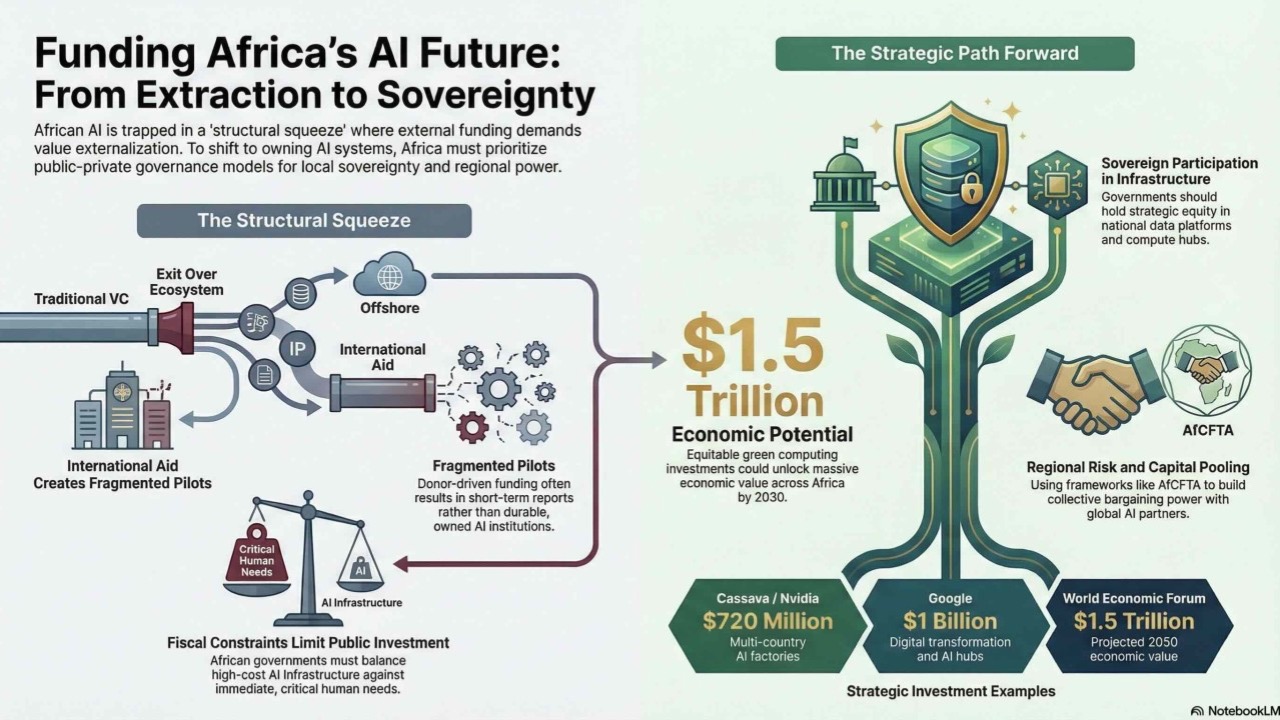
In earlier episodes of this series, we examined two uncomfortable truths.
First, that Africa risks being automated out of the AI economy if it participates only as labor and data, not as an owner of systems and value.
Second, that many of the social safety nets proposed for a post-AGI world, such as Universal Basic Income, are fiscally unrealistic for most African states under current economic models.
These two realities converge on a deeper question that is rarely addressed directly:
Who will fund Africa’s AI future, and under what terms?
AI development is not just a technological challenge. It is a capital-intensive, governance-heavy undertaking. And without deliberate funding models, Africa’s AI trajectory will be shaped by external incentives rather than internal priorities.
Why Traditional Funding Models Fall Short
This funding gap is not theoretical. I have experienced it firsthand.
Last year, we pitched CropSense AI, our context-aware agricultural intelligence platform, to a major international investor during a pan-African tech summit in Lagos. The feedback was glowing.
“This is game-changing for African agriculture.”
The problem was not belief in the technology. It was belief in African context.
The term sheet came with strings. Data generated by African farms would need to be mirrored offshore “for model improvement.” Core IP would be domiciled outside the continent to “de-risk future exits.” Market expansion priorities would be driven by regions with faster dollar-denominated returns, even if that meant deprioritizing smallholder farmers in favor of export-oriented use cases.
None of these conditions were framed as hostile. They were presented as standard practice.
But taken together, they revealed the core limitation of prevailing funding models: they optimize for investor security, not ecosystem sovereignty or long-term public value.
This is not unique to CropSense AI. It is a pattern.
Venture capital, as currently structured, rewards rapid scaling, centralized control, and clean exit paths. It is poorly suited to funding AI systems that depend on local data stewardship, long-term public trust, and alignment with national development goals.
International aid and grant funding, while essential, often sits at the opposite extreme. Projects are time-bound, donor-prioritized, and fragmented. They produce pilots, dashboards, and reports, but rarely durable AI institutions with ownership, continuity, and leverage.
Public funding alone cannot bridge the gap. Most African governments operate under tight fiscal constraints, balancing debt service, infrastructure deficits, and social spending. Large-scale AI investment competes with immediate human needs.
The result is a structural squeeze.
African founders are told to build locally relevant AI, but funded in ways that require externalizing value. Governments are urged to adopt AI, but without ownership or bargaining power. Data is celebrated as Africa’s new oil, yet extracted under terms that leave little behind.
This is not a failure of ambition or capability.
It is the predictable outcome of funding models that were never designed to support sovereign, context-aware AI development.
The Promise of Public-Private Partnerships
If Africa is to build an AI ecosystem that supports leapfrogging rather than exclusion, funding must be reimagined as a governance question, not merely a financial one.
Governments cannot fund this alone, and the private sector won't fund the "public good" aspects of AI. We need a hybrid approach: Public–private models offer a path forward, but only if designed deliberately.`
At their best, such models allow governments to de-risk long-term AI investments, anchor development to national and regional priorities, and retain strategic control over data and infrastructure.
And they allow private capital to participate in scalable, credible AI markets, share upside without monopolizing ownership, and invest in systems with long-term relevance rather than short-term hype.
We are already seeing early signals of this shift.
Real-world examples abound: Google's $1 billion commitment to African digital transformation supports AI hubs; Microsoft's Africa Development Center partners with education ministries for skills training. In Rwanda, Cassava Technologies' $720 million partnership with Nvidia builds Africa's first AI factory across multiple countries.
These models can unlock $1.5 trillion in economic value by 2030 through green computing investments, as per the World Economic Forum. When structured equitably, PPPs bridge gaps in compute, data, and expertise, fostering the homegrown foundations discussed in Episode 1.
The key is who sets the rules.
Governance Models for Equitable Investment
Equitable funding demands robust governance. Several principles should guide Africa’s approach.
1. Sovereign participation in AI infrastructure Governments and regional bodies should hold equity or strategic stakes in foundational AI assets, such as national data platforms, compute hubs, and sector-specific models. This is not about crowding out private capital, but about ensuring public value capture.
2. Regional pooling of capital and risk No single African country can fund AI at scale alone. Regional vehicles, aligned with frameworks like the AfCFTA, can pool demand, capital, and bargaining power. Shared infrastructure reduces duplication and strengthens negotiating positions with global partners.
3. Conditional private investment Public incentives, tax breaks, and market access should be tied to clear conditions: local capacity building, data localization where appropriate, transparency, and long-term ecosystem development. Access without obligation reproduces dependency.
4. Rethinking development finance Multilateral and bilateral funders should shift from fragmented pilots to co-investment in durable AI institutions. This includes funding governance capacity, regulatory tooling, and local research, not just applications.
5. Linking AI returns to social stability As explored in Episode 5, Africa cannot rely on traditional UBI models. But AI-driven value created using African data and markets must contribute to social resilience, whether through digital dividends, public revenue sharing, or targeted social investment mechanisms.
From Passive Capital to Strategic Investment
Funding decisions are never neutral. They determine who owns infrastructure, who controls data, who sets standards, and who benefits when systems scale. In the AI era, they also determine whether automation deepens inequality or supports inclusive growth.
Africa does not need charity. It needs strategic capital governed by African priorities.
Public–private AI funding models are not a concession. They are a recognition that in an economy driven by data, compute, and automation, sovereignty is exercised as much through balance sheets and governance structures as through laws.
The question is not whether money will flow into Africa’s AI ecosystem. It already is.
The real question is whether that capital will entrench dependency, or help finance a future in which Africa owns a meaningful share of the intelligence shaping its societies.
That choice, like so many in this series, is still open.
Next Episode
In Episode 8, “Cybersecurity in the Age of AI: Protecting Africa’s Digital Borders from Global Threats”, we confront the vulnerability at the heart of Africa’s digital transformation. If Episode 7 asked who funds and owns our AI infrastructure, the next question is even more urgent: who protects it? As AI systems become embedded in healthcare, finance, governance, and national infrastructure, cybersecurity is no longer a technical afterthought. It is the frontline of sovereignty.
We will examine how AI is reshaping the threat landscape through deepfakes, automated cyberattacks, and systemic platform dependence, and why Africa must shift from reactive security models to AI-native defense strategies. Because in the age of intelligent systems, protecting data is not enough. We must protect the digital borders that define our economic and national security future.