Blog / AI & Data Governance in Africa
The Price of Automation: Why Africa Cannot Copy Western UBI in a Post-AGI World
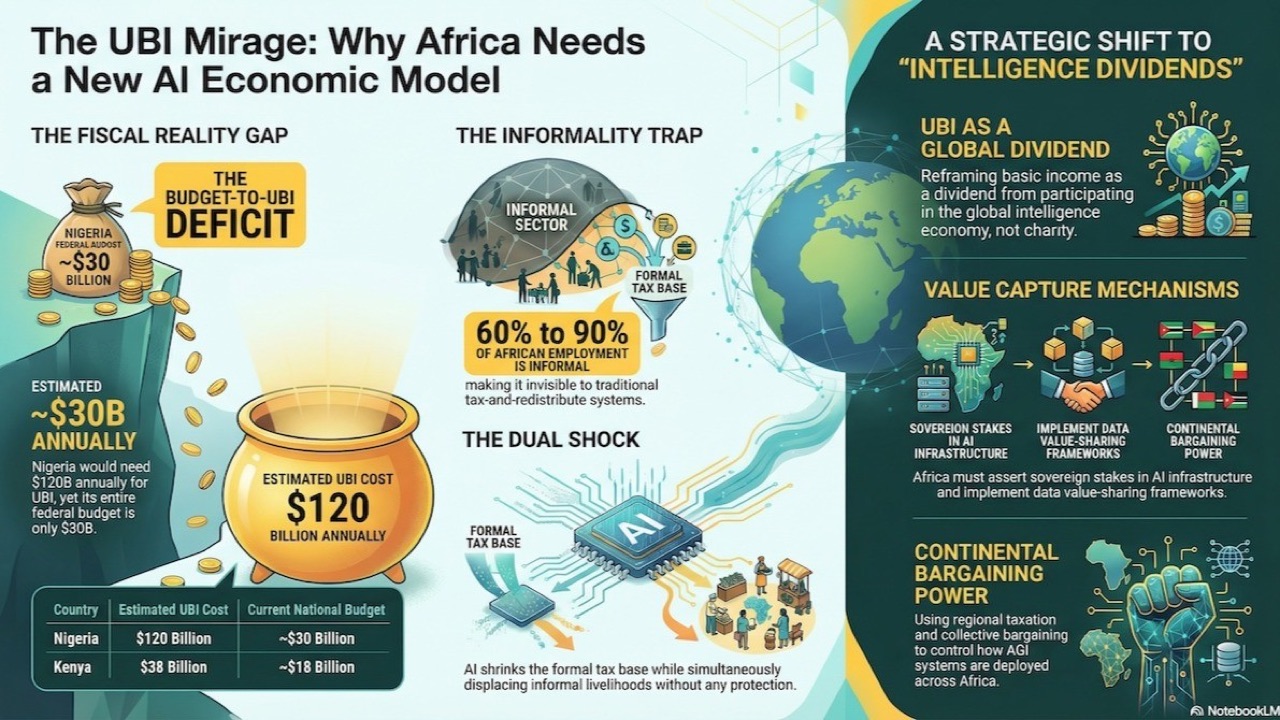
The conversation about Artificial General Intelligence and its economic consequences has largely been a Western affair. In Silicon Valley and other technology capitals, debates focus on mass automation, the declining relevance of human labor, and Universal Basic Income as a social stabilizer. These discussions unfold with an implicit assumption: that all societies will face similar disruptions and possess comparable policy tools to respond.
Africa does not share that assumption, and the assumption is dangerously wrong.
When AI systems become capable enough to automate most categories of cognitive and physical labor, the disruption will be global. The capacity to respond will not be. Universal Basic Income, the policy solution most frequently proposed to manage technological unemployment, depends on conditions most African nations do not currently possess: deep fiscal reserves, broad tax capture of automated value, and institutions capable of redistributing income at scale.
The question, then, is not whether Africa should prepare for a post‑AGI economy. It is what happens when the solution most of the world reaches for is one Africa cannot realistically implement, and whether the global AI community is prepared to confront that asymmetry.
The UBI Mirage: Why the Math Doesn't Work
In many policy circles across the continent, Universal Basic Income is already dismissed as unrealistic. Government revenues are thin. Informality is pervasive. Tax bases are narrow. Even existing social protection programs struggle with coverage and efficiency. With high debt burdens and competing demands for basic infrastructure, a traditional, tax‑funded UBI at meaningful levels appears fiscally out of reach.
Nigeria, Africa’s largest economy, would need roughly $120 billion annually to provide a modest basic income of $100 per month to its adult population. Its entire federal budget is approximately $30 billion. Kenya would require about $38 billion for a similar program against a national budget of $18 billion. These are not marginal gaps. They are structural impossibilities under current economic models.
But this affordability debate rests on a deeper assumption: that the future economy should be taxed like the past one. That assumption becomes fatal once labor is no longer the primary unit of economic value.
In a post‑AGI world, value is generated not primarily by human effort, but by compute, data, and automated decision systems. If African data, markets, and behavioral signals continue to feed global AI systems without meaningful value capture, then Africa will indeed be unable to fund any form of large‑scale social protection.
The real question is not whether Africa can afford UBI today. It is whether Africa can absorb mass technological displacement without any replacement mechanism tomorrow.
The Informality Trap: Automation Without Protection
Africa’s labor structure magnifies this risk. Between 60 and 90 percent of employment across the continent exists in the informal sector. These jobs do not generate payroll taxes, do not contribute to social insurance, and do not appear fully in official labor statistics. Informality has long functioned as a survival system, compensating for weak formal institutions.
In an automated economy, that survival system becomes a liability.
UBI, as commonly conceived, depends on formal value capture. Yet Africa’s economic activity remains largely invisible to the fiscal systems required to redistribute income. As AI automates formal sector roles, government revenue erodes. At the same time, informal workers face growing competition from AI‑enabled platforms that operate at scale but contribute little to local public finances.
This produces a dual shock. Formal jobs disappear, shrinking the tax base. Informal livelihoods face displacement without protection. The capacity to respond collapses precisely as social need explodes.
The result is not merely unemployment. It is a fiscal and social feedback loop that weakens states while amplifying instability.
Who Pays the Price? A Question of Externalities
If Africa cannot afford widespread UBI, the costs fall unevenly, and predictably on the most vulnerable. Young people entering labor markets with shrinking demand. Women concentrated in precarious service roles. Rural populations that are already distant from formal economic opportunity. Graduates facing obsolescence before their first job. Informal economies contracting without alternatives.
In the absence of structured redistribution, societies improvise. Crime rises. Migration accelerates. Extremist movements find recruits. These are not speculative outcomes; they are patterns observed whenever large populations are excluded from economic participation.
There is a deeper injustice embedded here. Global AI systems generate immense productivity gains, often trained on data sourced from across the world, including Africa. The economic upside accrues to firms and states with the capacity to tax and regulate AI‑driven value. The downside of displacement is localized, absorbed by societies with the weakest safety nets.
Africa is, in effect, subsidizing the global AI economy, while paying the social costs of exclusion.
The Conversation We Should Be Having Now
Africa’s task is not to replicate Western UBI debates. It is to redefine the terms of the discussion.
Basic income in a post‑AGI world cannot be treated as charity or emergency relief. It must be reframed as a dividend from participation in a global intelligence economy. That requires new mechanisms:
- Sovereign stakes in AI infrastructure
- Data value‑sharing frameworks
- Regional taxation of AI‑enabled services
- Continental bargaining power over how AGI systems are deployed
The tragedy is not that Africa lacks final answers. No one does. The tragedy is that these questions are barely being asked. While global forums focus on alignment and long‑term AGI risk, the near‑term economic consequences for regions with fragile fiscal capacity remain marginal to the debate.
African policymakers and technologists should be modeling these scenarios now. What happens if 30% of formal jobs disappear without fiscal buffers? How do remittance‑dependent economies adapt when white‑collar roles automate abroad? What claims can Africa assert if AGI‑driven wealth concentration deepens global inequality?
Delay weakens negotiating power. Early engagement creates leverage.
A Call for Clarity, Not Comfort
The question posed here is not rhetorical.
Can Africa afford Universal Basic Income in a post‑AGI world? Not as currently designed. Not under existing fiscal models. And not while the value generated by AGI concentrates in jurisdictions that control the technology.
And if Africa cannot afford it, who pays the price?
African workers without safety nets. African governments facing instability without tools. African youth inheriting economies with shrinking opportunity. African societies bearing the costs of a transition they did not design and from which they capture little value.
This outcome is not inevitable. But avoiding it requires Africa to treat AGI economics as a strategic priority, not a distant concern. The future is rarely kind to those who arrive late to its design.
Next Episode
If economics determines who benefits from AI, talent determines who shapes it. As automation accelerates and AI systems concentrate value around data, compute, and expertise, Africa faces a quieter but equally consequential risk: losing the innovators needed to build and govern its AI future.
In Episode 6, “Africa’s AI Talent Pipeline: Governance Strategies to Retain Innovators and Combat Brain Drain”, I examine why talent flight is not just a market outcome but a governance failure, how policy gaps and weak research ecosystems push African AI talent outward, and what it would take to retain, anchor, and scale innovation on the continent in an age of global competition for intelligence.