Blog / AI & Data Governance in Africa
Is Your AI Blind to Africa? Why Homegrown Data Is the Key to Unlocking Fair AI
In the early rush of the generative AI boom, I was building a system to detect insurance fraud. I was excited about the possibilities. Finally, we could analyze claims at scale, spot suspicious patterns, and protect both insurers and honest customers.
But as I fed the model real insurance claims from African markets, something disturbing emerged.
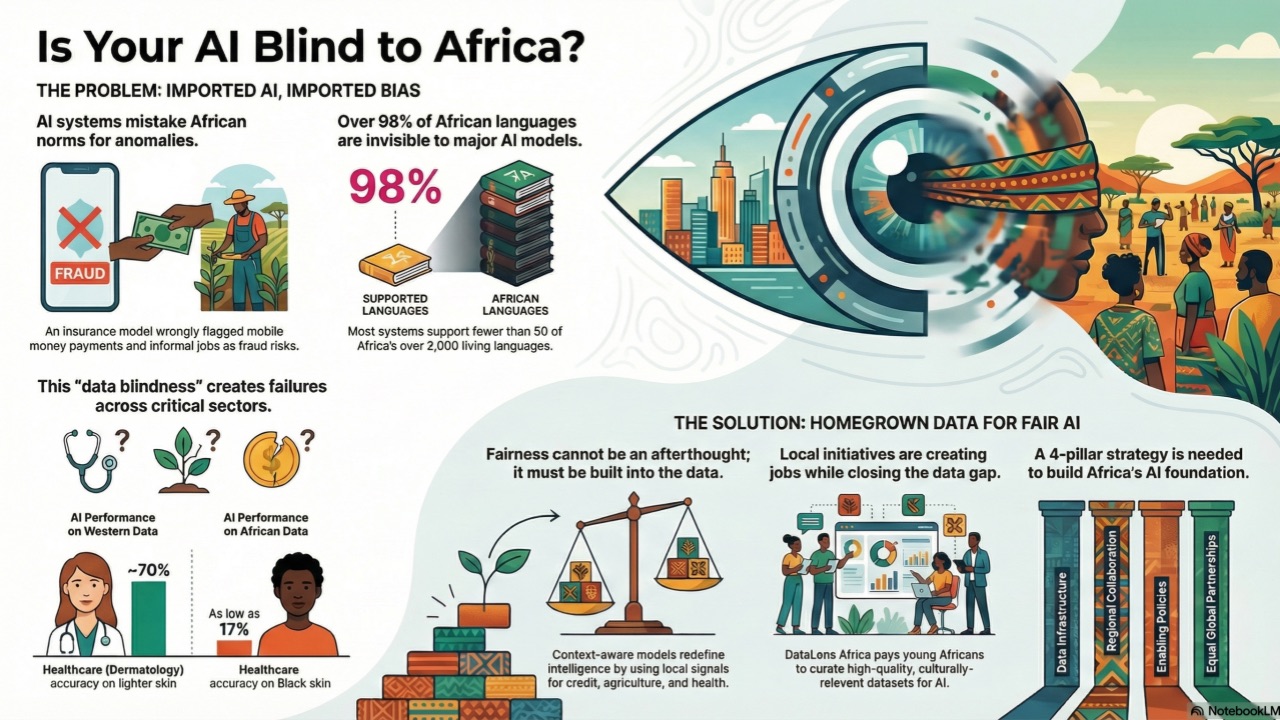
Legitimate claims were flagged as suspicious at alarming rates. A policyholder who paid premiums through mobile money? Flagged. A claim involving treatment at a local clinic without the “standard” documentation format? Flagged. Someone whose employment history did not follow the neat, linear path of formal sector jobs? High risk.
The system was not detecting fraud. It was detecting Africa.
Every deviation from Western financial norms triggered an alert. The AI had learned what “normal” looked like, and normal did not include us.
That is when it became clear: the AI was not broken. It was blind. Blind to our context, our realities, and our way of doing business.
Imported Data, Imported Bias
The root of the problem is deceptively simple. Most AI systems today are trained primarily on data from North America, Europe, and parts of Asia. When deployed in African contexts, these systems carry the assumptions, biases, and blind spots of the environments they were built for.
The consequences are visible across sectors.
In healthcare, studies have shown that AI systems trained predominantly on lighter-skinned patients significantly underperform on darker skin tones. In one widely cited dermatology study, diagnostic accuracy dropped from around 70% on lighter skin to as low as 17% on Black skin, a stark example of how data imbalance can translate directly into harmful outcomes.
In agriculture, AI optimized for large-scale industrial farms in temperate climates struggles to support smallholder farmers dealing with tropical weather patterns, indigenous crops, and soil types that are barely represented in global datasets.
In finance, AI penalizes informal economies. It fails to interpret mobile money histories, cooperative savings groups, and trust-based business relationships that underpin much of African commerce.
Systems designed to democratize opportunity end up reinforcing exclusion. This is not a model failure. It is a data failure.
Fair AI Begins With Homegrown Data
Africa is not simply underrepresented in global datasets. It is structurally different, and that difference demands intentional, local data foundations.
Consider what fairness actually requires:
1. Linguistic reality: Africa has over 2,000 living languages. Yet most large multilingual language models support fewer than 50 African languages in practice. That means more than 98% of African languages remain effectively invisible to mainstream NLP systems.
2. Cultural context: Meaning is shaped by gesture, tone, symbols, and social norms. Models trained primarily on Western expressions routinely misinterpret African communication.
3. Infrastructure constraints: AI optimized for high-bandwidth, always-on environments fails where connectivity is intermittent and mobile data is expensive.
4. Economic structure: Informal economies, cash-light systems, and community-based trust networks require entirely different signals of creditworthiness and risk.
Fairness cannot be retrofitted at the end of the pipeline. It must be embedded at the source. And the source is data that reflects lived African realities.
Imagine a credit model trained not only on bank statements, but on mobile money histories, cooperative contributions, and community repayment behavior. Or an agricultural model grounded in indigenous crop varieties, local soil classifications, and regional climate patterns.
These systems do not lower standards. They redefine intelligence through context.
What Homegrown Data Looks Like in Practice
At CipherSense AI, we made a deliberate choice from day one: we would not build AI systems for Africa using data from somewhere else. That choice is harder, slower, and more expensive, but it is the only way AI actually works here.
This philosophy is not theoretical. It is embedded in the products we own and operate.
With CropSense AI, instead of adapting Western agricultural models wholesale, we build yield intelligence using satellite imagery combined with hyper-local African data signals. The platform integrates earth-observation data with localized climate patterns, soil conditions, and on-ground context to improve yield predictions and farm-level decision-making for African farmers.
With DataLens Africa, we address two challenges at once: Africa’s data gap and youth unemployment. Young Africans earn income curating high-quality, context-rich datasets. They label local environments, transcribe African accents, and validate whether AI truly understands our cultural norms.
They are not extracting value for foreign platforms. They are building the data foundations for their own future.
The pattern is consistent: when AI is built on contextual data, it works. When it is not, it fails predictably and expensively.
Building Africa’s Data and AI Foundation
Across the continent, researchers, startups, universities, and data communities are beginning to close the gap. But the pace must accelerate. Four priorities are critical:
1. Investment in data infrastructure: Not just servers and storage, but people, data engineers, domain experts, ethicists, and researchers grounded in local realities. This includes initiatives like national soil data registries and public health datasets built locally.
2. Regional collaboration: Shared frameworks for cross-border data and model development, such as pan-African language corpora and agricultural data standards, designed with sovereignty and privacy in mind.
3. Enabling policy environments: Governments must support local data generation while protecting citizens’ rights and ensuring responsible AI use.
4. Global partnerships on equal terms: Africa must participate as a co-creator of AI systems, not merely as a source of raw data or a testing ground.
Is Your AI Blind to Africa?
Here is the uncomfortable truth: any AI system that does not understand African people, African languages, African economies, or African environments is, by design, biased against Africans.
When a system misreads informal livelihoods, fails to understand African accents, or produces flawed insights because it was never trained on African realities, the issue is not just inaccuracy. It is systemic bias, embedded at the data layer and expressed through unequal outcomes.
The path to fair, trustworthy, and effective AI on the continent begins with homegrown data: data collected, curated, and governed by Africans, and grounded in how African societies actually function.
If we want AI that truly sees us, understands us, and serves us equitably, then we must build it ourselves.
Because AI that cannot see Africa will never work for Africa.
Next Episode
This piece introduces the AI and Data Governance in Africa series and sets the foundation for the conversations ahead, starting with the data layer where bias and power are embedded.
In Episode 2, I examine a defining choice for the continent: Can Africa use AI to leapfrog development, or will poorly governed automation widen inequality and dependency? We will analyze what it takes for AI to drive inclusive growth rather than structural displacement.