Blog / AI & Data Governance in Africa
The Silent War for African Data: Sovereignty, Security, and Strategy
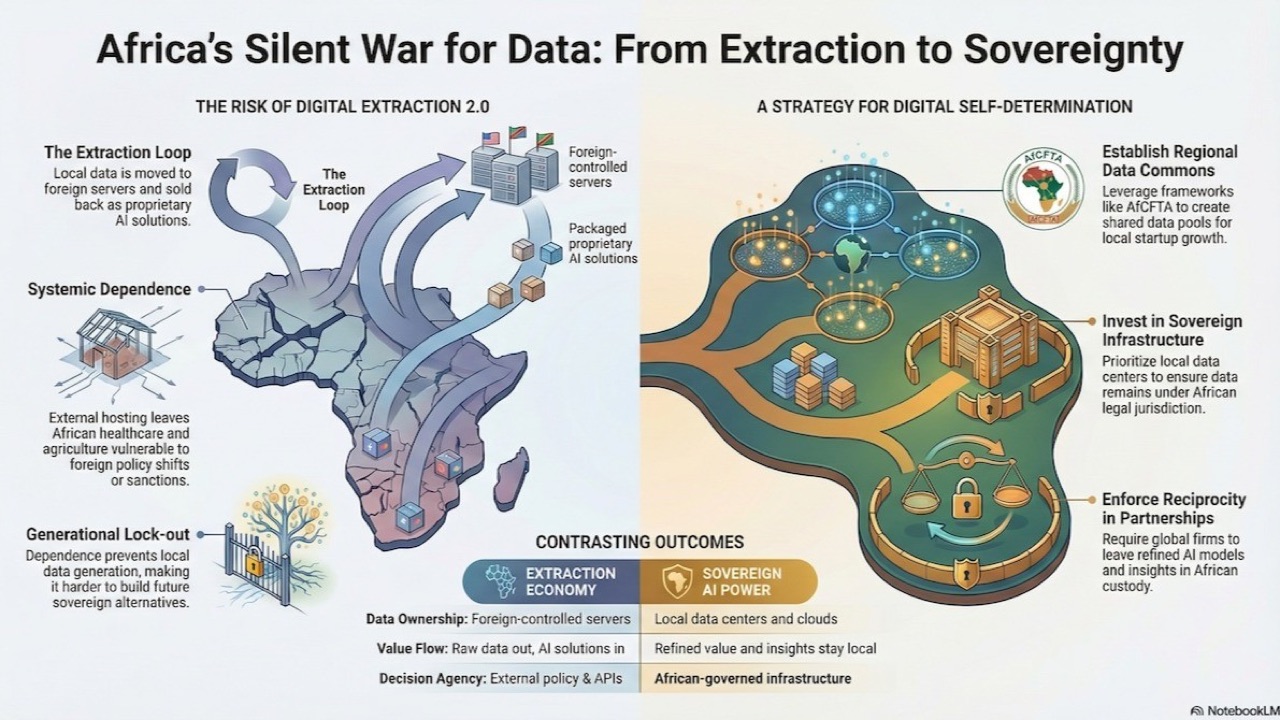
In my previous reflections, I argued that context is a moat and that homegrown data is the only way to build AI that truly sees us. But as African institutions begin to curate local datasets, a quieter and more consequential conflict is emerging beneath the surface.
It is no longer just about whether the data exists; it is about who owns it, where it lives, and who decides its future.
Here is what the global AI industry understands, but rarely states openly: the era of advantage built purely on model scale is nearing its limits. As architectures converge and compute becomes more accessible, durable advantage is shifting toward something more defensible and far harder to replicate: exclusive access to high-quality, domain-specific data.
The most sophisticated AI labs are no longer just racing to build bigger models. They are racing to secure exclusive access to unique datasets that cannot be replicated. And Africa, sitting on some of the world's most unique and underutilized datasets, is at the center of this struggle, whether we realize it or not.
This is a conversation we haven't yet had loudly enough.
The Extraction Economy, Version 2.0
History has a haunting way of repeating itself in digital formats. In earlier eras, raw materials were extracted from the continent to fuel industrial revolutions elsewhere. Today, we see data extraction: Global platforms often collect African behavioral, financial, and health data, move it to servers in northern jurisdictions, and use it to train proprietary models that are then sold back to us as "solutions".
When African data is extracted without sovereignty, we lose more than just privacy; we lose revenue and the ability to set our own strategic direction. If the "digital brains" of our healthcare, agricultural, or educational systems are hosted and governed entirely outside our borders, our core functions become vulnerable to external policy shifts, sanctions, or corporate pivots.
This extracted data is not just information. It is the raw material of the AI economy. And whoever controls it controls the models, the insights, the products, and ultimately, the economic value that flows from it.
Why Data Sovereignty Matters Now
Data sovereignty is often misunderstood as a call to retreat from global innovation. In reality, it is about agency, not isolation.
Sovereignty means African countries, institutions, and companies retain meaningful control over how data is collected and labeled, where sensitive datasets are stored and how resulting systems are deployed and monetized.
Without this control, Africa risks repeating a familiar historical pattern: exporting raw value and importing finished intelligence at a premium. The stakes are higher this time because AI systems do not just extract economic value; they shape narratives, automate decisions, and encode assumptions into the infrastructure of society.
When those systems are built without African governance, African realities are filtered through external priorities.
The Overlooked Security Dimension
When data security is discussed, attention usually centers on cyberattacks, leaks, and regulatory compliance. These risks are real, but they miss the deeper vulnerability: systemic dependence. If financial systems rely on models they cannot audit, if public health planning depends on analytics they do not govern, and if food security strategies are shaped by platforms that can be repriced, restricted, or withdrawn, then security in the AI era is no longer just about keeping attackers out, it is about preserving decision-making autonomy.
Consider a scenario that is increasingly common: an AI-driven public health system, funded by an external partner, is deployed across multiple African countries. It predicts outbreaks, allocates resources, and informs policy. Yet the model, trained on locally sourced health data, is hosted and controlled abroad. In a crisis, who determines whether a novel disease pattern is flagged as a regional concern or escalated as a global security issue? Who sets the alert thresholds, and whose priorities shape the response?
This is not science fiction. When data and models that underpin critical public systems fall outside domestic governance, sovereignty and security become inseparable. In the AI era, data sovereignty is not a regulatory preference, it is a national security imperative.
A Strategy for Digital Self-Determination
No single African nation can counterbalance global technology power alone. To move from being a source of raw data to a sovereign AI power, we must adopt a continental strategy focused on three specific pillars:
1. Regional Data Commons
We must leverage frameworks like the AfCFTA to create shared data pools that give African startups the scale they need to compete.
2. Sovereign-First Infrastructure
We cannot have data sovereignty if our data resides on servers we do not own. We must prioritize local data centers and "sovereign cloud" initiatives.
3. Reciprocity in Partnerships
Any global firm accessing African data must ensure that a portion of the refined value, the models and insights, remains in African custody for local innovation.
Together, these pillars implemented collectively creates the foundation for an African AI ecosystem that can innovate locally, negotiate globally, and govern its digital future on its own terms.
The Cost of Inaction: A Generational Debt
The greatest risk Africa faces is not the presence of AI, but exclusion from its governance.
If Africa fails to secure data sovereignty today, the cost will not be measured in missed opportunities alone, but in a new and enduring form of structural poverty called digital disenfranchisement.
Inaction locks us into a future where African economies remain consumers of intelligence rather than producers of it. Where governments license insights about their own citizens from foreign platforms. Where startups build on APIs they do not control, under pricing models they cannot influence, and legal regimes they did not shape.
It means African creditworthiness determined by algorithms trained on Western financial behavior, agricultural recommendations optimized for climates thousands of miles away, and public policy guided by systems that treat informality, community networks, and local resilience as statistical noise.
It also means a silent talent drain. Our brightest engineers become “ghost workers”, labeling data, moderating content, and fine-tuning models for global firms, without equity, ownership, or long-term leverage. Value accrues elsewhere, while capability stagnates at home.
Most dangerously, once this dependency hardens, it becomes self-reinforcing. The more foreign models shape our systems, the less local data we generate under our own terms. The less local data we control, the harder it becomes to ever build sovereign alternatives. This is not a temporary lag but a generational lock-out.
Data sovereignty, then, is not a defensive posture. It is a prerequisite for economic self-determination in the AI age. The question is no longer whether Africa can afford to act, but whether it can afford not to.
Next Episode
Africa is not a single market, polity, or regulatory environment, and any attempt to govern AI as though it were will fail. In Episode 4, “One Continent, Many Strategies: Reimagining AI Governance for Africa’s Collective Future,” I will explore how African countries can pursue different national AI strategies while still aligning on shared continental principles.
We will examine what should be governed locally, what requires regional coordination, and where Africa must speak with one voice to avoid fragmentation, regulatory arbitrage, and weakened bargaining power in the global AI economy.