Blog / AI & Data Governance in Africa
Sustainable AI for Africa: Balancing Innovation with Environmental and Resource Constraints
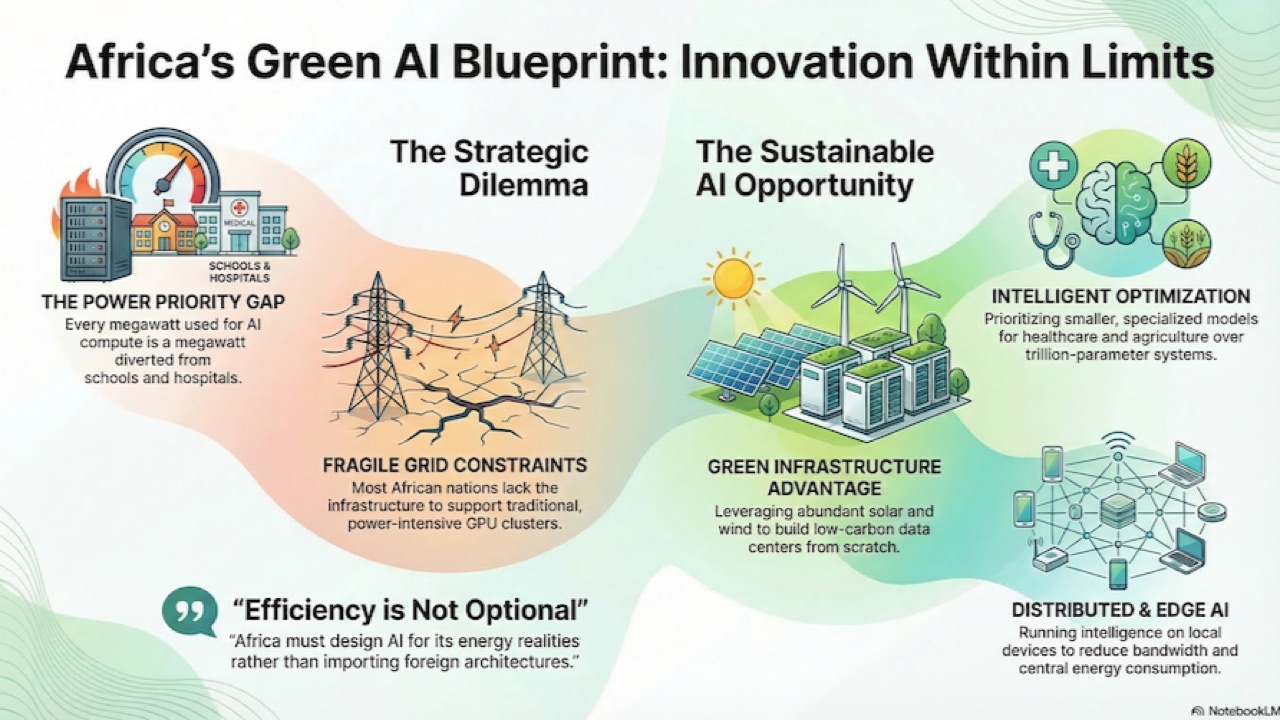
Artificial intelligence is often framed as an engine of limitless innovation. Yet, behind its elegant interfaces lies a stark physical reality: data centers consuming megawatts of electricity, massive GPU clusters generating heat, and global supply chains extracting rare minerals to power the infrastructure of computation. For Africa, AI development is inseparable from the question of sustainability.
The continent is simultaneously one of the most energy-constrained and climate-vulnerable regions in the world. While many countries still struggle to provide stable electricity to households, the global AI race demands power-intensive infrastructure to train and run large-scale models. This creates a strategic dilemma. If Africa simply replicates the infrastructure-heavy models of the Global North, the environmental and economic costs may outweigh the benefits.
However, by treating sustainability as a design principle, Africa can pioneer a new paradigm: efficient, resilient, and context-aware AI systems built specifically for resource-constrained environments.
The Hidden Environmental Cost of AI
The global AI boom has triggered an unprecedented surge in demand for energy and computational infrastructure. Training large foundation models requires thousands of GPUs operating for weeks or months, consuming enormous quantities of electricity. For industrialized economies, this is a challenge of scaling, but for Africa, it is a challenge of prioritization.
In many African nations, electricity grids remain fragile, energy access is uneven, and renewable capacity is still scaling. Allocating scarce power to compute-heavy AI raises difficult questions, as every megawatt dedicated to infrastructure is a megawatt that cannot power a hospital, school, or factory.
This does not mean Africa should slow down on AI. It means we must design an AI ecosystem aligned with our energy realities rather than importing architectures built for different environments.
Efficiency is not optional. It is strategic.
The Resource Constraint Opportunity
Ironically, Africa’s resource constraints may become a long-term advantage. While highly capitalized ecosystems rely on brute-force scaling, larger models, and bigger data centers, this path is increasingly expensive and unsustainable. Africa has the opportunity to explore an alternative focused on intelligent optimization.
This approach includes:
1. Smaller, Specialized Models: Focusing on domain-specific systems optimized for agriculture, finance, and healthcare provides higher practical value with less compute.
2. Edge and Distributed AI: Running models on mobile devices or local compute nodes reduces bandwidth costs and energy consumption.
3. Data Efficiency: Prioritizing high-quality, curated datasets over brute-force collection reinforces the need for structured data ecosystems.
The Green Infrastructure Strategy
If AI infrastructure is inevitable, the real question is how it is built. Africa has a rare opportunity to build green AI infrastructure from the ground up rather than retrofit legacy systems.
Key advantages include:
1. Abundant Renewable Energy Potential: Solar, wind, hydro, and geothermal resources can power a new generation of low-carbon data centers.
2. Emerging Digital Infrastructure: Systems still being built can integrate efficiency, modularity, and sustainable cooling from day one.
3. Strategic Position in Global Compute Networks: As demand grows, compute will become more distributed. Africa can position itself as a sustainable compute hub.
Realizing this requires coordinated investment and policy that treats AI infrastructure as both a technological and environmental priority.
Policy Priorities for Sustainable AI
Africa is uniquely positioned to build green AI infrastructure from the start rather than retrofitting legacy systems. With abundant renewable energy potential in solar, wind, and hydro, purpose-built data centers could position the continent as a sustainable compute hub.
True leadership in the AI age may not belong to those who build the biggest systems, but to those who build the most sustainable ones. Africa’s history of innovation under constraint suggests the continent is uniquely capable of developing technologies optimized for resilience. Instead of competing with trillion-parameter models, Africa can define leadership through practical intelligence designed for real-world impact.
Conclusion: Innovation Within Planetary Limits
Artificial intelligence will shape the trajectory of the 21st century. But it cannot exist outside planetary limits. For Africa, the challenge is sharper. The continent must expand digital infrastructure, strengthen energy systems, and participate in the AI economy while navigating climate and development pressures.
The path forward is not to slow innovation, but to align it with sustainability from the start. By prioritizing efficient architectures, green infrastructure, and responsible governance, Africa can avoid the pitfalls already emerging elsewhere.
In doing so, the continent can build not just a viable AI future, but a global blueprint for sustainable intelligence.
The Vision Ahead: Beyond the Series
This episode concludes our Data & AI Governance in Africa series, but the work of building a sovereign, sustainable future has only just begun. We are transitioning from the "what" and "why" of governance into the "how" of deployment.
The mission of "AI Built on Local Context" continues. Moving forward, this newsletter will shift its focus toward the frontier of Enterprise AI, exploring how these technologies are being applied across industries to solve uniquely African challenges. We will take you behind the scenes of our work at CipherSense AI , where we are engineering the tools that reflect our identity, honor our resource constraints, and secure our data sovereignty.
The era of passive adoption is over. The era of African-led, context-aware intelligence is here.
Stay tuned.