Blog / AI & Data Governance in Africa
Cybersecurity in the Age of AI: Protecting Africa's Digital Borders from Global Threats
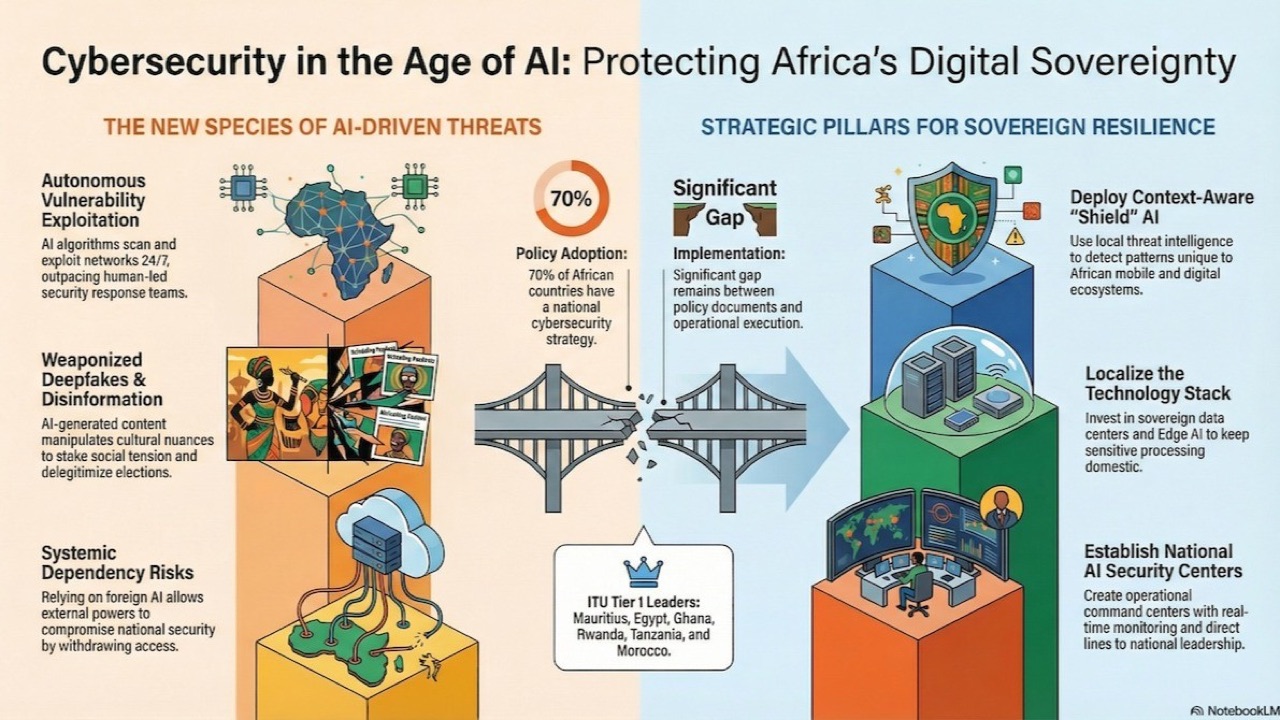
AI governance is inseparable from cybersecurity. While AI-driven automation promises progress, it also introduces systemic risks where a single breach can result in the theft of national sovereignty and the sabotage of public trust. As argued in Episode 3, data sovereignty is national security. Today, Africa’s digital borders are under siege by autonomous, adaptive threats operating at machine scale—an environment our nascent infrastructure is currently ill-equipped to defend.
The Warning Shot: Lessons from the Global Stage
The events of February 28, 2026, have redefined the global AI landscape. Coinciding with US and Israeli military strikes in Iran, the US government designated Anthropic—a domestic AI leader—as a supply-chain risk to national security. This designation, triggered by Anthropic’s refusal to grant unrestricted military access to its models, signals that AI has transitioned from a commercial product to a primary weapon of state power. For Africa, the lesson is clear: in times of conflict, AI access is determined by national security imperatives, not market dynamics.
AI-Driven Threats: A New Species of Attack
The cybersecurity challenges Africa faces today are qualitatively different from anything we have encountered before. AI has not just made existing threats faster, it has created entirely new categories of attack that must now be understood through a national security lens.
1. Deepfakes and Disinformation: AI-generated content weaponizes cultural nuances to stoke ethnic tension or manipulate elections before verification can occur. This is a direct challenge to democratic sovereignty.
2. Automated Vulnerability Exploitation: Algorithms now scan networks and craft exploits 24/7, overwhelming human security teams. African institutions running legacy systems are at the intersection of maximum vulnerability and minimum preparedness
3. Systemic Dependence as a Vulnerability: Relying on foreign AI for core sectors creates a kill switch vulnerability. If a platform is withdrawn due to geopolitical shifts, national security is instantly compromised.
Africa is not just a target, it is a testing ground. The tools being refined in less-defended digital environments today will be deployed at scale tomorrow. The question is whether Africa will be a passive subject of that testing, or an active architect of its own defenses.
Building a Resilient African Security Strategy
Protecting our digital borders requires moving beyond importing security software. We must build sovereign resilience through strategic priorities that treat AI as a matter of national security, not a convenience to be licensed from abroad.
1. National AI Security Centers: Every We must move from policy committees to operational centers with real-time monitoring and direct lines to national security leadership.
2. Context-Aware Defense Systems: We require homegrown threat-intelligence models trained on African internet traffic and mobile money ecosystems.
3. Resilient, Localized Infrastructure: To avoid Extraction Economy 2.0, sensitive data and processing must remain on the continent within sovereign-first, green data centers.
4. AI-Powered Defense at Scale: We must deploy machine-learning systems capable of responding to anomalies at machine speed, utilizing open-source tools for cost-effective, continental defense.
5. The Truth Infrastructure Mandate:National strategies must prioritize AI tools that can authenticate media in real-time to protect the integrity of public discourse.
6. Proactive Auditing and Backdoor Detection: Mandatory security audits for AI in critical sectors are essential to detect backdoors installed by external actors.
Rethinking National Cybersecurity Strategies
According to the 2024 ITU Global Cybersecurity Index, leaders like Mauritius, Egypt, Ghana, Rwanda, Tanzania, and Morocco have achieved Tier 1 'Role Modeling' status. This is genuinely commendable progress. But it is not enough. Most of these strategies were designed in a pre-AI world, and none were designed for a world where AI itself has become a weapon of interstate conflict. National cybersecurity must now be rebuilt around the reality that AI can be turned against its users.
1. From Laws to Execution: While roughly 70% of African countries have some form of national cybersecurity strategy, implementation remains the "silent gap".
2. Regional Defense Commons: No nation can stand alone. We must use the AfCFTA framework to create unified cybersecurity standards and rapid-response threat-sharing networks
Conclusion: Security as the Foundation of Trust
Cybersecurity in the AI age is not a technical luxury; it is a prerequisite for economic self-determination. The events of February 28, 2026, have given Africa an unusually clear view of its future, a future in which the AI systems that power economies, governments, and militaries are battlegrounds in their own right.
Sovereignty is symbolic without the capacity to defend, audit, and if necessary replace the systems on which a nation depends. The countries that will benefit most from AI are not those that deploy it fastest. They are those that deploy it safely, strategically, and on their own terms, with the sovereign capacity to defend, audit, and if necessary, replace the AI systems on which their nations depend.
Next Episode
In Episode 9: “AI and African Democracy: Safeguarding Elections and Public Discourse from Manipulation” we move from protecting digital infrastructure to defending the most fragile pillar of sovereignty: democratic legitimacy. How do we safeguard the public will when AI can manufacture speech, video, and narrative at machine scale? We will examine how deepfakes, propaganda, and platform dependencies create new vulnerabilities for African states. In an age of synthetic media, defending sovereignty means defending the integrity of our elections and the trust that sustains them.