Blog / AI & Data Governance in Africa
One Continent, Many Strategies: Reimagining AI Governance for Africa's Collective Future
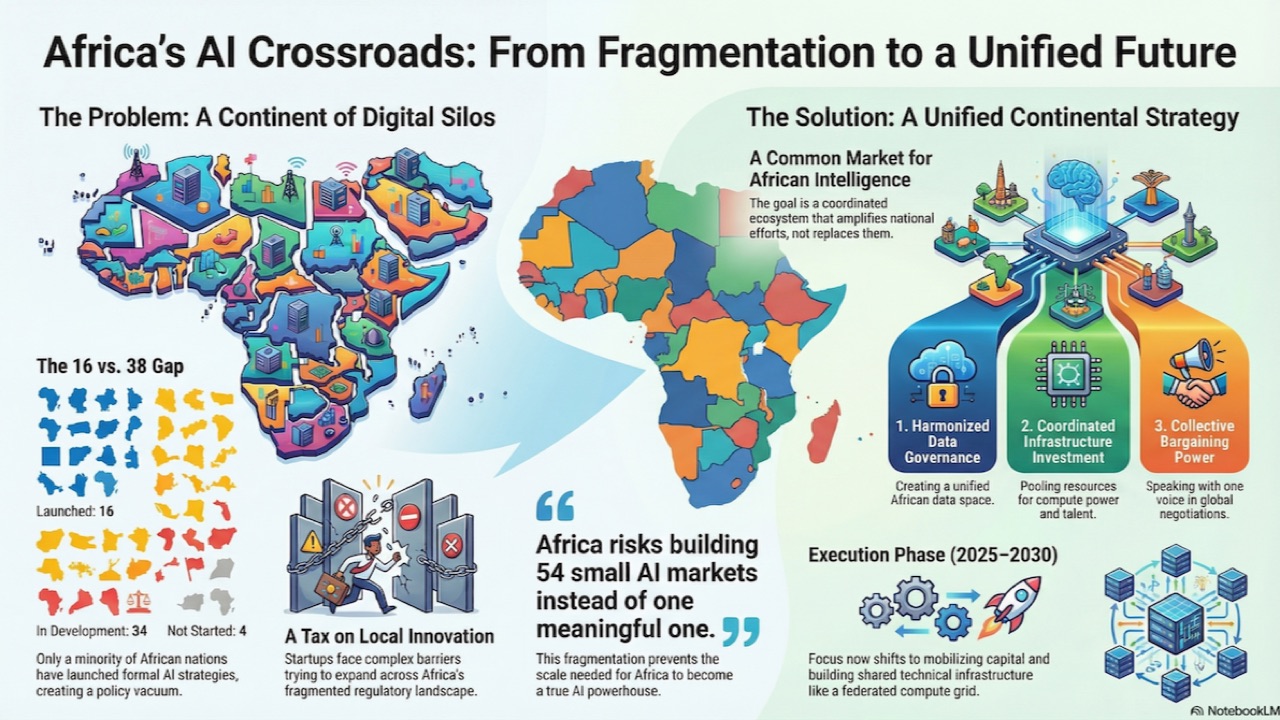
In my ongoing exploration of Africa's place in the AI ecosystem, I have emphasized the foundational role of data in shaping technologies that reflect our realities. In my previous post, I examined the silent war for African data, how context serves as a moat and why securing local data is the first step toward sovereignty. As we move from collecting data to building the systems that govern its use, a new danger has emerged: governance fragmentation.
Across the continent, a gold rush of national AI strategies is underway. As of late 2025, over a dozen African nations have launched or are drafting independent AI frameworks. While this appears on the surface as progress and signals a welcome awakening to the AI age, closer examination reveals a more troubling pattern: a patchwork of disconnected policies, duplicated efforts, and competing visions that risk fragmenting the continent's AI future before it even begins.
The question is not whether African countries should have AI strategies. They should, and many do. The question is whether fifty four separate strategies, each designed in isolation, can collectively position Africa as a meaningful player in a global AI landscape increasingly defined by scale, interoperability, and network effects.
The Landscape of Fragmentation
The current state of AI governance in Africa is a study in contrasts. We see early movers like Mauritius, which launched Africa’s first AI strategy in 2018, and Egypt, which is already on its second-generation strategy covering 2025 to 2030. Countries like Rwanda have leaned into security and Responsible AI as a national brand, while Nigeria has adopted a bottom-up collaborative approach through its AI Collective.
However, this individual progress masks a growing divide. According to the Oxford Insights Government AI Readiness Index 2025, which assesses governments' capacity to adopt and deploy AI across six pillars (including Policy Capacity, Governance, Infrastructure, Public Sector Adoption, Development & Diffusion, and Resilience), Egypt leads the continent at 51st globally (scoring 57.5), followed by strong Sub-Saharan performers such as Kenya (65th), South Africa (67th), Mauritius (71st), and Nigeria (72nd). These rankings reveal that while early frameworks provide a foundation, actual readiness varies widely due to differences in sustained investment, infrastructure, and public-sector integration, with many countries lagging despite ambitious plans.
This divide manifests in several ways:
- Regulatory Mimicry vs. Local Reality: Many early frameworks were copied from global standards like the EU AI Act or GDPR. While these provide a baseline, they often fail to account for the informal economies and community based data structures that define African life.
- The 16 vs. 38 Gap: Only about 16 African countries have official national AI strategies. The remaining 38 nations operate in a policy vacuum, making them vulnerable to policy dumping or exploitative terms from global technology giants.
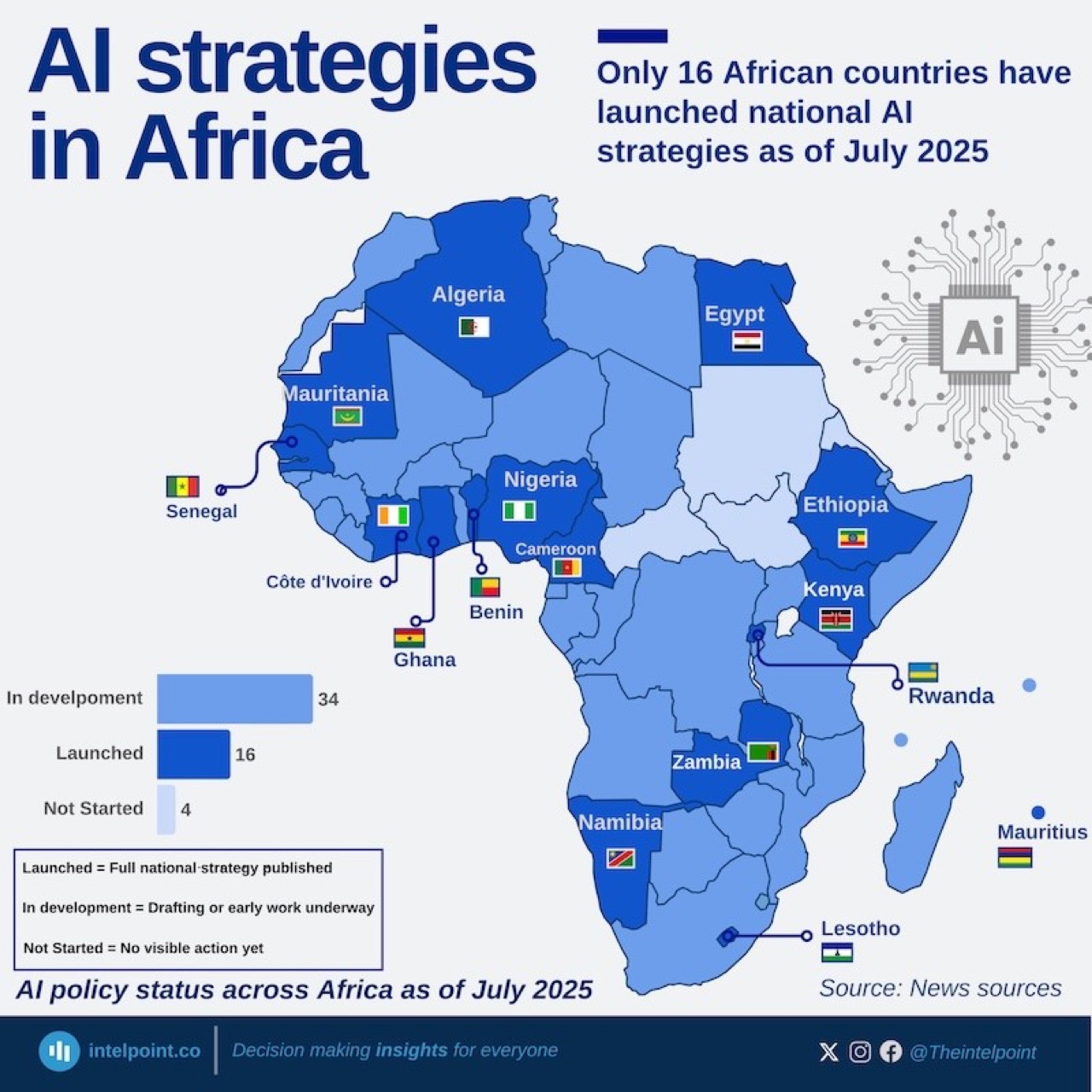 Source: AI Policy Status Across Africa by IntelPoint.
- Compliance Barriers: For an African startup, expanding from Lagos to Nairobi or Accra, it currently means navigating three different sets of data localization rules and ethical standards. This fragmentation functions as a structural tax on local scale, making it easier for a Silicon Valley firm with deep legal resources to dominate the continent than for a local startup to cross its own borders.
The Patchwork Problem
A review of emerging AI strategies across the continent reveals recurring patterns. Some countries emphasize AI as a tool for public sector efficiency. Others frame it as an enabler of startup ecosystems and foreign investment. A few focus heavily on ethics and risk, often borrowing language from European frameworks. Many blend all three, constrained by limited capacity and external advisory influence.
Strategic coherence is missing across these efforts. Definitions of AI vary. Priority sectors differ. Governance institutions are duplicated. Regulatory timelines are misaligned. Even basic concepts such as data access, model accountability, and cross border deployment are treated inconsistently. An AI system deemed compliant in one African country may be legally ambiguous or outright restricted in another.
This matters because AI value chains do not respect national borders. Models trained in one jurisdiction are deployed in others. Talent circulates regionally. Data flows across borders by default. Fragmented governance introduces friction where scale should exist.
In practical terms, Africa risks building 54 small AI markets instead of one meaningful one.
The Case for a Continental AI Strategy
A continental AI strategy is not about replacing national sovereignty with centralized control. It is about establishing the minimum viable layer of coordination that allows national strategies to amplify rather than cancel each other out. It is about creating the connective tissue that transforms isolated efforts into a functioning ecosystem.
The release of the AU Continental AI Strategy in July 2024 was a pivotal moment. A reimagined collective approach to AI governance is not about erasing national nuance. It is about creating a unified common market for African intelligence.
A Continental AI Strategy requires agreement on a limited set of foundational elements that enable interoperability without dictating implementation details. At minimum, such a strategy must address three core domains:
1. Harmonized Data Governance
Standards that allow for cross border data flows under African terms. This does not mean identical data protection laws, but it does mean mutual recognition frameworks, standardized consent protocols, and shared approaches to data localization that balance privacy with innovation. The goal is to create an African data space where information can move as freely within the continent as it does within the European Union, but under governance structures that serve African interests.
2. Coordinated Investment in Shared Infrastructure
No single African country can afford to build world class AI research facilities, high performance computing clusters, and talent development pipelines at scale. But collectively, through mechanisms like the African Development Bank or regional economic communities, resources can be pooled.
3. Collective Bargaining Power
Africa must arrive at unified positions through inclusive continental dialogue in global AI governance negotiations. When fifty four nations speak as one, the terms of engagement with global foundation model providers change.
Beyond Strategy: From Policy to Power (2025–2030)
The African Union has set a bold timeline. The 2024 to 2025 preparatory phase has concluded, and the implementation phase covering 2025 to 2030 has begun. This is a decisive window where the Silent War for data sovereignty will be won or lost. Africa must move beyond drafting white papers and toward the friction of execution.
Three execution pillars now matter most.
1. Operationalizing the Africa AI Council: Africa needs more than a deliberative body. It needs a technical clearinghouse. The Council must orchestrate cross border regulatory sandboxes, allowing a fintech startup in Dakar to test models in Johannesburg under a unified African AI passport.
2. Capitalizing the $100 Billion Ambition: While the proposed $60 billion Africa AI Fund is a start, the infrastructure and talent gap is far larger. Implementation requires mobilizing domestic capital, including sovereign wealth funds and pension funds, so that Africa’s AI future is financed by African balance sheets, not only foreign grants.
3. Forging the African Compute Grid: Strategy without compute remains symbolic. Africa must pursue a regional approach to high performance computing. Instead of fifty four underfunded national data centers, a federated grid of tier one AI labs across regional blocs can ensure equitable access to compute, regardless of geography.
Conclusion: The Choice of a Generation
The history of Africa is often told as a story of borders drawn by others, lines on a map that fractured a continent. In the AI age, the risk is a digital repetition of that history, a new partition defined not by geography, but by algorithmic dependence and regulatory silos.
Sovereignty was the first argument. Collective strategy is the necessary second. If Africa continues to act as fifty four individual players, it will remain a fragmented market of digital tenants, paying rent to global technology firms for access to its own intelligence. But if strategies align, Africa transforms into a singular economic bloc with negotiating power, scale, and agency.
Africa has the data. It has the talent. It now has a credible blueprint. The Silent War is no longer only about who owns the data. It is about who has the courage to govern it together. Reimagining AI governance for Africa’s collective future is not merely a policy exercise. It is the most consequential strategic choice of this generation.
The era of the fragmented consumer is ending. The era of the continental powerhouse must begin.
Next Episode
Governance determines who controls AI, but economics determines who benefits from it. As African nations align strategies, build shared infrastructure, and negotiate collective power, a harder question emerges: what happens to work, income, and social stability as AI systems approach general capability?
In Episode 5, “The Price of Automation: Why Africa Cannot Copy Western UBI in a Post-AGI World” I examine whether existing social safety nets can survive large-scale automation, why traditional welfare models may fail in African economies, and how today’s AI governance decisions will quietly shape who bears the cost of technological progress tomorrow.