Blog / AI & Data Governance in Africa
AI and African Democracy: Safeguarding Elections and Public Discourse from Manipulation
Across this series, I have explored several pillars shaping Africa’s AI future: data sovereignty, harmonized governance, economic safeguards in the age of automation, and the urgent need to retain African AI talent.
Yet these structural issues converge around a far more immediate vulnerability: the integrity of democratic institutions.
Elections are the foundation of political legitimacy. Public discourse is the mechanism through which citizens form collective judgment. When these systems are manipulated, democracy itself becomes fragile.
Artificial intelligence is rapidly transforming this landscape.
For the first time in history, technologies capable of manufacturing persuasive political narratives at scale are widely accessible. Synthetic audio, AI-generated video, automated propaganda networks, and hyper-targeted messaging can influence millions of voters in minutes.
The question is no longer whether AI will affect African democracy. The question is whether it will become a tool for democratic participation or a weapon for manipulation.
The Emerging Threat Landscape
AI-driven political manipulation differs fundamentally from traditional disinformation campaigns. It operates faster, scales wider, and is increasingly difficult to detect.
Several new risks are already emerging:
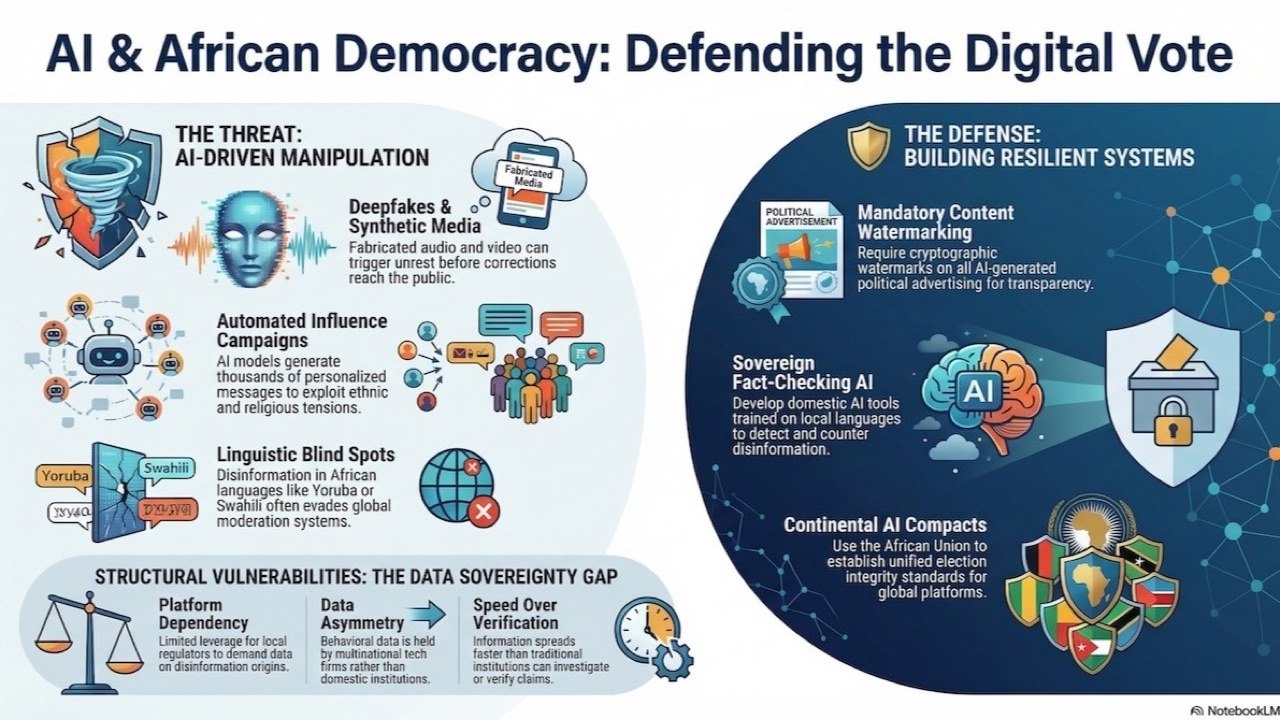
1. Deepfakes and Synthetic Media: AI-generated audio and video can fabricate speeches, political violence, or admissions of wrongdoing. In fragile electoral environments, even temporary misinformation can trigger unrest before corrections reach the public.
2. Automated Influence Campaigns: Large language models can generate thousands of personalized political messages targeting specific demographic groups, exploiting ethnic, religious, or regional tensions.
3. Narrative Engineering at Machine Scale: Generative AI allows rapid production of persuasive political narratives optimized for different audiences, languages, and emotional triggers.
4. Speed Over Verification: Information now spreads across social platforms faster than institutions can investigate or verify claims, weakening the effectiveness of traditional fact-checking.
What once required sophisticated propaganda infrastructure can now be executed by relatively small groups with access to generative AI tools.
Africa’s Structural Vulnerability: The Data Sovereignty Gap
These threats are magnified by structural characteristics of Africa’s digital ecosystem.
The platforms that host public discourse and the AI systems that enable synthetic media are largely developed and controlled outside the continent. This creates a dangerous asymmetry between those capable of manipulating narratives and the institutions responsible for protecting democratic processes.
Several vulnerabilities stand out.
Foreign Models, Local Divisions: Generative AI systems can be prompted to exploit local political tensions even when they lack deep contextual understanding. Meanwhile, many African electoral bodies lack equivalent tools to detect and counter such manipulation.
Linguistic Blind Spots: Most global content moderation systems are optimized for major languages such as English or French. Disinformation in African languages such as Yoruba, Swahili, or Amharic often evades automated detection.
Platform Dependency: When disinformation campaigns spread across global social media platforms, African regulators often have limited leverage to demand rapid intervention or access to data on the origin of such campaigns.
Data Asymmetry: The behavioral data used to target political messaging is often held by multinational technology companies rather than domestic institutions, creating an information imbalance that can be exploited.
In effect, Africa’s democratic information space is heavily dependent on digital systems outside sovereign control.
Building Resilient Democratic Defenses
Protecting elections in the age of AI requires moving from reactive responses to proactive governance.
Several strategic priorities should guide policy:
1. AI Content Watermarking: Electoral commissions should require cryptographic watermarking of AI-generated political advertising and campaign media to ensure transparency.
2. Sovereign Fact-Checking AI: African governments and research institutions must develop AI tools trained on local languages and cultural contexts to detect deepfakes and disinformation.
3. A Continental Democratic AI Compact: Through the African Union, countries could establish unified standards requiring social media platforms to prioritize election integrity across the continent.
4. Digital Literacy and Public Awareness: Citizens must be equipped with the skills to identify manipulated media and misinformation through large-scale digital literacy programs.
5. Platform Accountability: African regulators must collectively engage global technology companies to ensure that election integrity protections deployed in other regions are equally applied in African political contexts.
Conclusion: Defending the Integrity of the Public Will
Political sovereignty in the digital age is no longer defined only by territorial borders. It is increasingly defined by control over information ecosystems.
If external actors can manipulate narratives, distort public perception, and influence electoral outcomes through algorithmic systems, democratic legitimacy becomes vulnerable.
Defending African democracy therefore requires more than secure ballots. It requires the capacity to detect, audit, and counter AI-driven information warfare.
The nations that succeed in the AI era will not simply be those that adopt new technologies fastest. They will be those that build the institutions capable of governing those technologies responsibly.
Next Episode
In Episode 10, “Sustainable AI for Africa: Balancing Innovation with Environmental and Resource Constraints,” we conclude the AI and Data Governance in Africa series by examining one final but critical dimension of the continent’s AI future.
Artificial intelligence is often discussed purely in terms of innovation and economic opportunity. Yet behind every AI system lies physical infrastructure, data centers, energy consumption, and global supply chains that carry real environmental and resource implications.
For a continent already navigating energy access challenges and climate vulnerability, the question becomes unavoidable: How can Africa build an AI ecosystem that is both technologically ambitious and environmentally sustainable?
And as we approach the final installment, I want to sincerely thank readers who have followed this series, engaged with the ideas, and contributed to the ongoing conversation about Africa’s AI future.
The dialogue we build today will help shape the systems we live with tomorrow.