Blog / AI & Data Governance in Africa
Can Africa Leapfrog the AI Revolution or Will We Be Automated Out of It?
Over the past year, my conversations as a founder have taken a darker turn.
Friends working at global tech companies within and outside Africa are being swept up in repeated “global restructurings.” Talented engineers in Lagos, Nairobi, and Accra, people who only recently believed they had secured a foothold in the global tech economy, are suddenly back on the job market.
At the same time, many African founders are confronting a harsher reality. Venture capital is retreating. Fundraising rounds that once took months now stretch into years, if they happen at all. Increasingly, capital that might have backed African startups is being redirected toward large-scale AI bets in the United States, Europe, and parts of Asia.
These are not isolated events. They are early signals of a deeper global shift.
And they force a difficult but unavoidable question:
Will Africa leapfrog into the AI era, or be automated out of it before we truly participate?
This is not an abstract debate. It will shape the economic future of over 1.4 billion people and determine whether Africa’s youth become builders of the AI economy or casualties of it.
The AI Paradox: Promise and Precarity
AI holds real promise for Africa.
Intelligent diagnostics could extend healthcare to underserved regions. AI-driven agriculture could help smallholder farmers adapt to climate volatility. Language technologies could unlock access across Africa’s extraordinary linguistic diversity. Generative AI could lower barriers to software development and innovation.
But the risk is just as real.
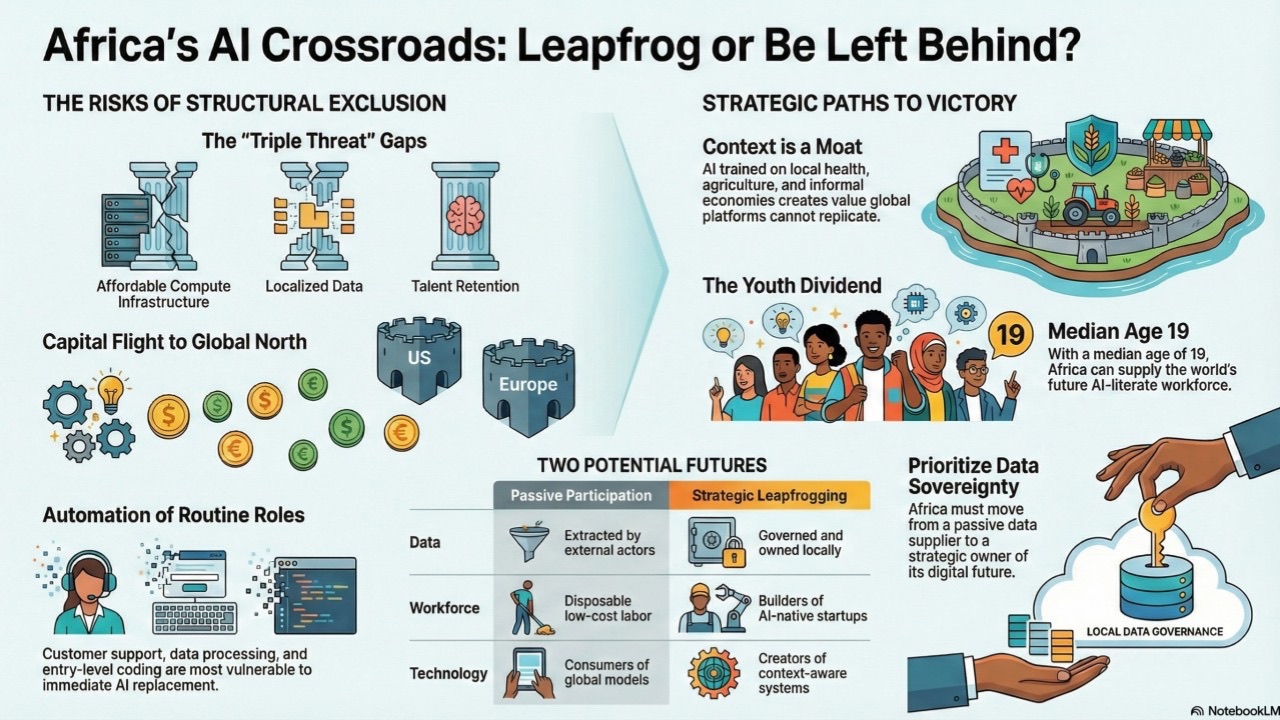
Many of the jobs currently employing millions of Africans, customer support, data processing, routine administrative work, and even entry-level software tasks, are exactly the roles AI is learning to automate first.
If Africa participates in the AI economy primarily as a source of low-cost labor while value creation and ownership remain elsewhere, automation will not empower us. It will marginalize us.
A Reality Check: Compute, Data, and Talent
The AI revolution rests on three foundations: compute, data, and expertise. Africa currently faces structural gaps across all three.
Compute: Training and deploying modern AI systems requires stable electricity and affordable computing infrastructure, still inconsistent and costly across much of the continent. While cloud platforms help, their costs often put serious AI development out of reach for startups and researchers.
Data: Most global AI systems are trained on data that barely reflects African languages, economies, or social realities. When African data is collected, it is frequently extracted by external actors, with limited value returning to local ecosystems. Without data sovereignty, Africa risks becoming invisible in the AI systems shaping global decisions.
Talent: Africa has no shortage of capable minds, but brain drain remains severe. Talented researchers and engineers are pulled abroad by better-funded institutions, while universities struggle to keep curricula aligned with the pace of AI advancement.
These are not failures of ambition. They are structural disadvantages, and they will not correct themselves.
Where Africa Can Actually Win
Africa does not need to compete head-on with Silicon Valley on foundation models or hyperscale compute.
Our advantage lies elsewhere.
1. Solving African problems first: AI systems trained on African health data, agricultural conditions, informal economies, and local languages create defensible value that global platforms cannot easily replicate. Context is a moat.
2. The youth dividend: With a median age of just 19, Africa has the youngest population in the world. If this demographic advantage is paired with large-scale AI literacy and skills development, Africa could supply talent to an AI-driven world while other regions face workforce shortages.
3. Regulatory opportunity: African nations are not locked into legacy AI governance models. By designing pragmatic, innovation-friendly frameworks that protect citizens while enabling experimentation, Africa can become an attractive environment for responsible AI development.
4. Regional scale: No single country can build AI capacity alone. But collectively, through frameworks like the AfCFTA, Africa represents a market large enough to justify shared AI infrastructure, regional data commons, and cross-border research institutions.
The Path Forward: A Continental AI Strategy
Leapfrogging into the AI era will not happen organically. It requires coordinated action across policy, capital, and execution.
- Invest in foundational infrastructure: Reliable power and affordable internet are not optional; they are economic infrastructure for the AI age.
- Build African AI institutions: Centers of excellence focused on African challenges must be funded to attract, retain, and develop top talent.
- Create African datasets: Health, agriculture, language, climate, and economic data must be collected, governed, and owned locally.
- Scale AI literacy: AI understanding must extend beyond engineers to policymakers, business leaders, and workers whose jobs will be affected.
- Support AI-native startups: Africa needs commercially viable AI companies that retain value locally, not just research pilots.
- Collaborate strategically: Global partnerships must build African capacity, not simply extract data or talent.
Automation Is Not the Enemy. Exclusion Is.
So, will Africa be automated out of the AI revolution?
Some degree of job displacement is inevitable. Automation will affect call centers, routine coding, and basic data work everywhere, not just in Africa.
The real danger is exclusion.
Africans using AI tools built elsewhere, governed elsewhere, and monetized elsewhere, while local opportunities quietly disappear.
History offers both a warning and a lesson. Regions that failed to industrialize during earlier technological revolutions paid the price for generations. But Africa’s leapfrogging of landlines through mobile technology shows that late entry does not mean inevitable loss, if strategy aligns with opportunity.
A Choice, Not a Destiny
Africa’s position in the AI revolution is not predetermined. It is being shaped right now, by where capital flows, how policies are written, what data is collected, and which skills are prioritized.
One future turns Africa into a passive source of data and disposable labor. The other makes the continent a hub for AI systems built for the Global South, by people who understand its realities.
The difference lies in deliberate choices made today.
The AI revolution will not wait for Africa to catch up. But if there is one constant in Africa’s history, it is the ability to innovate when forced to chart a different path.
The question is no longer whether Africa can leapfrog the AI era.
It is whether we choose to.
Next Episode
In Episode 3, “The Silent War for African Data: Sovereignty, Security, and Strategy,” I will examine who is capturing African data, how it is being governed, and what is at stake if the continent remains a passive supplier rather than a strategic owner.
We will explore data sovereignty, cross-border data flows, national security risks, and the hard choices African governments and institutions must confront to protect their digital future.